Sequence Memory Test
Squares light up one at a time on a 4×4 grid. Tap them back in the same order and see how long a sequence you can reproduce.
Tap the squares back in order
- Watch each square light up
- Wait until they all stop
- Tap them back in the same order
How to read your score
| Score | What it means |
|---|---|
| Under 3.5 steps | A weighted span under 3.5 steps in this Sequence Memory Test means the three-square sequences were not yet coming back reliably, and 1.0 steps is the lowest score the test can produce. Read the error breakdown next: wrong-square errors say a position was lost, while wrong-order errors say the positions were held but the order slipped. A first run often lands here simply because the 400-millisecond flash rhythm is new. This describes one run of one task, not a ranking against other people. |
| 3.5-4.9 steps | A weighted span of 3.5-4.9 steps in this Sequence Memory Test means four-square sequences were coming back part of the time while five-square ones were not yet holding. The decimal is a sum of pass rates across the lengths you were shown, so 4.5 never means a sequence of four and a half squares appeared. Compare it with your own completed tests on the same device and screen size rather than with anyone else's number. |
| 5.0-6.4 steps | A weighted span of 5.0-6.4 steps in this Sequence Memory Test means five- and six-square sequences were being reproduced fairly often while the seven-square ones mostly were not. Clearing every length from three through six and missing all three seven-step rounds gives exactly 6.0. Weighted span describes consistency across lengths; the longest exact run reported beside it records your single best round. It is the middle band of this test, not the middle of a population. |
| 6.5-7.9 steps | A weighted span of 6.5-7.9 steps in this Sequence Memory Test means seven-square sequences were coming back more often than not, with room left below the test's 9.0-step ceiling. Keep one encoding strategy across runs if you want numbers this high to be repeatable, since switching between remembering a path and remembering labelled cells changes what is being measured. This is a band for this task, not a percentile and not a label for the player. |
| 8.0 steps and above | A weighted span of 8.0 steps or more in this Sequence Memory Test sits at or just below its maximum of 9.0 steps, which is reached by clearing all eight scored rounds including both nine-square ones. A 9.0 means the test ran out of longer sequences to show, not that your limit was found: the ceiling belongs to this test's design. No population percentile is being reported at any point on this scale. |
These five bands explain weighted span only for this Sequence Memory Test: a fixed 4×4 grid, 400 milliseconds per square and 200 milliseconds between them. Higher is better, but the bands are not percentiles, population averages or health standards. Compare several completed tests on the same device.
How to play
- How do you take an online sequence memory test?: Press Start. One unscored practice round of two squares comes first, then eight scored rounds beginning at three. The board stays in the same position for the whole session, so nothing moves while you are watching.
- How does a sequence memory test show the sequence?: Squares light one at a time: each stays on for 400 milliseconds with a 200 millisecond gap before the next. Those two timings never change with sequence length. Taps during playback are refused and do not select anything.
- How do you answer a sequence memory round?: After the last square goes dark, tap the squares in the same order they lit. Order is what this test scores, so one tap out of turn ends the round immediately — there is no undo and no second attempt.
- How do you interpret a sequence memory test score?: Finish all eight scored rounds, then read the weighted span in steps; higher is better. Check it beside your longest exactly reproduced run and your usable-round count, then compare several completed tests taken under the same conditions.
What this measures
A Sequence Memory Test is one unscored practice round of two squares followed by eight scored rounds. The first scored round is three squares long on a fixed 4×4 grid.
Each square in a sequence memory sequence lights for 400 milliseconds, with a 200 millisecond dark gap before the next one. Neither timing grows with sequence length, so the number of steps is the only thing that changes.
A sequence memory round is correct only when every square is tapped in the order it lit. Tapping a square that never lit and tapping a square out of turn are both wrong, and the result card counts the two kinds separately.
Two behaviours that feel like faults in a sequence memory test are deliberate. Taps made while the squares are still lighting are refused and select nothing, because accepting them would change the display you are trying to encode; and a second tap landing on the same square a moment after the first counts as one tap, so a shaky finger does not end the round. Playback always runs its full length and cannot be cut short or extended by tapping.
The next sequence gains one step after a correct answer and loses one after two wrong answers in a row. Sequence length stays between two and nine steps, and a mistake never ends the test early.
The answer window is two seconds plus 0.9 seconds per step, starting when the last square goes dark. Running out of time counts as a failed round rather than disappearing from the result.
Weighted sequence memory span starts from the shortest sequence shown minus one, then adds your pass rate at each length reached. Clearing every length from three through six and missing all three seven-step rounds produces 6.0 steps.
A Sequence Memory Test score requires at least six of eight scored rounds to be answered in time and every square to have been shown for its full 400 milliseconds. Leaving the page, refreshing or switching apps during a session ends it without a score.
For a useful sequence memory comparison, use several completed tests on the same device, screen size and viewing setup. Read weighted span for consistency, longest exact run for your single best round, and usable rounds for test completeness.
To practise a sequence memory test in a way that means something, hold three things steady across runs: one encoding strategy, one device and one viewing distance. Then read the trend in weighted span over several completed tests instead of chasing a single high round. Improvement here is improvement at reproducing spatial sequences on this grid and timing; it is not evidence of a change in general memory.
FAQ
What is a sequence memory test?
A sequence memory test shows a series of positions one at a time and asks you to reproduce them in the same order. This one lights single squares on a fixed 4×4 grid, 400 milliseconds each with a 200 millisecond gap, across one unscored practice round and eight scored rounds that begin at three squares and reach nine at most. The result is a weighted span in steps rather than a pass or fail.
What does a sequence memory test measure?
This Sequence Memory Test measures how long a spatial sequence you can reproduce immediately after seeing it, across eight scored rounds with changing lengths. Both the positions and their order count. The result describes performance on this specific task, not general intelligence or a clinical condition.
What is a good sequence memory test score?
This Sequence Memory Test has no verified population average, so use its descriptive bands: under 3.5, 3.5-4.9, 5.0-6.4, 6.5-7.9, and 8.0 steps or more. Higher is better, but these are task-specific bands rather than percentiles. Compare several completed tests under the same conditions instead of reading one unusually high or low result.
How is the weighted sequence memory span calculated?
The span starts from the shortest sequence you were shown minus one, then adds your pass rate at each length you met, rounded to one decimal. Clearing three, four and five, clearing both six-step rounds, then running out of time on two seven-step rounds and getting the third one right gives 6.3 steps. That is deliberately not the same as the longest run you reproduced, which is reported separately.
How do you improve your sequence memory score?
Work on the encoding rather than the tapping: watch the whole flash sequence as a single path across the grid instead of naming squares one by one, and start replaying only once you have the shape of that path. Some people number the cells 1 to 16 and memorise digits instead; that works, but it turns the task into digit memory, so those runs are not comparable with ones played by position. Pick one strategy, keep the same device and seating distance, and read the trend across several completed tests rather than your best single round.
Does practising a sequence memory test improve memory?
Practice reliably improves performance on the practised task, and that is the honest limit of what this test can show. Reviews of brain-training programmes find clear gains on the trained exercise, much weaker evidence of transfer to untrained tasks, and little support for everyday benefits (Simons et al., 2016). Read a rising weighted span as growing skill at reproducing spatial sequences, not as a change in general memory.
Is a sequence memory test the same as a spatial span test?
A spatial span test is the general family: any task that asks you to hold a series of positions and give them back in order. This sequence memory test is one member of that family, with a 4×4 grid, fixed 400 and 200 millisecond timing, one practice round and eight scored rounds of its own. Spans from different layouts and timings are not interchangeable, so a number from one spatial span test cannot be read against another.
How is a sequence memory test different from the Corsi block-tapping test?
The published Corsi block-tapping test uses nine blocks placed irregularly on a board, and the irregular layout is part of what makes it hard. This test is an adaptation that uses a regular 4×4 grid, its own timing, its own difficulty path and its own scoring, so its numbers cannot be exchanged with Corsi scores or with any clinical span score.
Why did a sequence memory test give no score?
A run ends without a score when fewer than six of the eight scored rounds were answered inside their time window, or when the page was left, refreshed or sent to the background partway through. A dropped frame or a square shown noticeably longer or shorter than its 400 milliseconds voids a run as well. Half a test would put unusable numbers into your own history, so the run is discarded and offered again rather than scored in part.
Related games
 MemoryVisual Memory TestMemorize lit cells on a 5×5 grid, tap the same positions after they disappear, and compare your weighted visual memory span across completed tests.Play1-2 min
 MemoryDigit Span TestDigits flash one at a time. Type them back in order and see how long a string you can hold.PlayAbout 60s
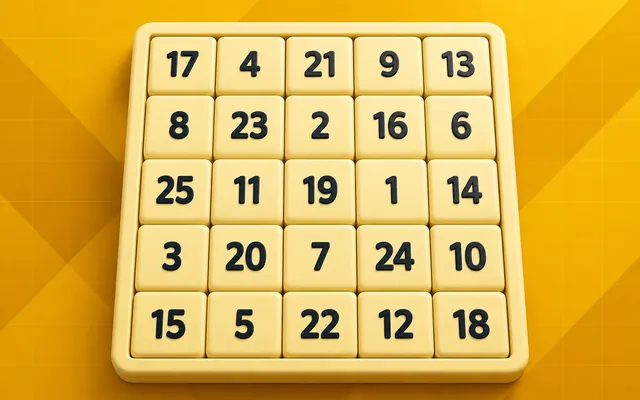 AttentionSchulte TableTap 1 to 25 in order on a shuffled grid and read your time in seconds.PlayAbout 40s
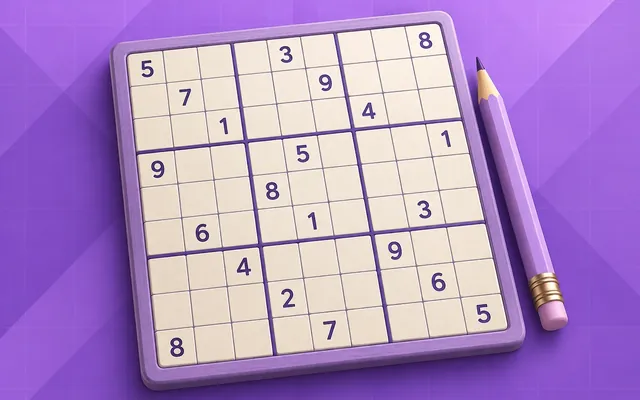 ThinkingSudokuMost of the grid is already filled. Finish the marked cells as fast as you can, and see what the clock says.PlayAbout 1 min
This test is for self-understanding and practice only, not a clinical or intelligence diagnostic tool. It is a non-standardised adaptation of a spatial sequence span task; its scores cannot be used interchangeably with clinical assessment scores.
Last updated: 2026-09-30 · Scores stay on this device