Reaction
Reaction tests measure the milliseconds between seeing something and acting on it. The tests here separate three of them: how fast you move on a bare signal, how much a decision costs you, and how steady your hand stays when targets keep coming.
Reaction3 games
 ReactionReaction Time TestWait for green, then press. See how quickly you react.PlayAbout 45s
 ReactionAim TrainerHit 30 targets as they jump around a fixed field and read your median time per target.PlayAbout 30s
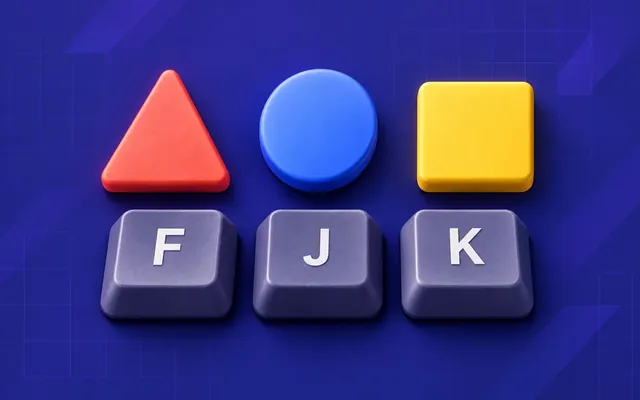 ReactionChoice Reaction Time TestFour shapes, four keys - press the one that matches.PlayAbout 45s
What reaction tests measure
Reaction time is the total interval between a signal appearing and your correct response landing, measured in milliseconds. It bundles three stages -- seeing, deciding, moving -- and no single test can pull them apart on its own.
That is why this category holds a set rather than one test. Simple reaction time asks only that you move when the screen changes. Choice reaction asks you to identify the signal first and pick the matching key. Aim training swaps the single press for continuous pointing. Run the first two and subtract: the difference is what one decision costs you, in milliseconds.
Who tests their reaction time
Three groups, mostly: competitive players who want to know where their hands sit relative to everyone else, people whose driving or work depends on reacting quickly, and people who are simply curious how far they are from the average.
They should not be reading the same number. For players, consistency matters more than the mean -- how many of ten trials drift past 300 ms says more than the average does. For drivers, the relevant figure is not this one at all; it is the full sequence of noticing, deciding and moving a foot, which runs in seconds. See the FAQ below.
How to read your score
Lower is better and the unit is milliseconds, but the number worth watching is the average across trials and how much it swings -- not your single best run. Eight of ten trials steady at 260 ms beats one at 190 ms and nine at 320 ms.
Browser measurements also run tens of milliseconds slower than lab equipment, which is the equipment talking, not you. Bridges et al. measured this across platforms in PeerJ (2020): browser-based tools carry a fixed visual presentation lag of roughly 15-67 ms and an input lag of roughly 8-48 ms. Switching devices switches rulers, so a personal best is only meaningful against your own scores on the same machine.
FAQ
What is a good reaction time
How do I test my reaction time accurately
Why is my reaction time slower on a phone
Can you improve your reaction time
What is the difference between simple and choice reaction time
What is the average driver reaction time
Does reaction time slow with age
Why does my reaction time vary so much between trials
Your scores are stored in this browser only. This site collects no personal data and never asks you to sign up.